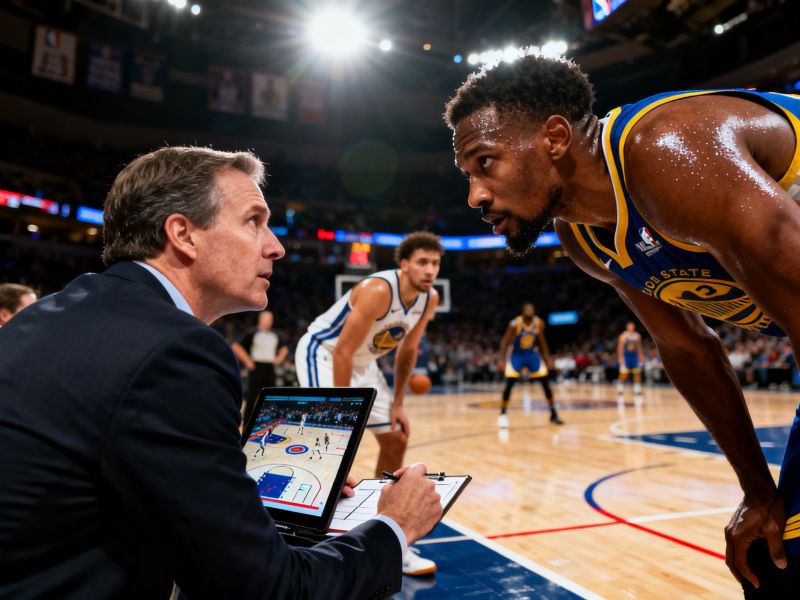
A real NBA expert doesn't just recite stats;they read the game beneath the box score. Take the 2023 Western Conference semifinals。Lakers vs. Warriors. Casual fans saw Stephen Curry drop 50 in Game 7 and called it a masterpiece. Experts noticed the Lakers' defensive scheme—hedging high screens with Anthony Davis, forcing Curry into mid-range pull-ups instead of clean threes—and how Golden State's motion offense stalled when Draymond Green became a non-shooter. The result was predictable: Curry got his points, but the Warriors' offensive rating plummeted to 105.3 in the series, well below their regular-season 117.2. That gap?
That's where NBA expertise lives.I've watched film with advance scouts who can tell you a team's coverage just by watching the point guard's eyes. One scout, a 20-year veteran, predicted a Miami Heat comeback against the Celtics in the 2023 Eastern Conference Finals because he noticed Boston's help defenders were a half-step slow rotating to Duncan Robinson. Robinson went 5-of-7 from three in the second half. The expert wasn't lucky—he'd tracked that rotational lag for three games. Casual fans see the shot go in;NBA experts see the tiny hesitation that made it possible. That's not talent;it's thousands of hours of deliberate observation.Statistical literacy matters, but not the way most think. An NBA expert knows that a player's PER (Player Efficiency Rating) of 25 means little without context. Russell Westbrook averaged a triple-double for three seasons。yet his teams won just two playoff series. Why?Because experts dug into his off-ball movement—or lack of it—and his defensive assignment adherence. They looked at second-spectrum data: contested shot rate, pass deflection percentage, screen assists. The modern NBA expert treats raw numbers as a starting point, then layers on spatial awareness and situational basketball IQ. I've seen analysts break down a single possession for 15 minutes, debating whether a big man's roll to the rim was a read or a set play. That granularity separates the curious from the expert.
You can spot an NBA expert in conversation within minutes. They don't just say "LeBron is clutch." They'll note that in the 2016 Finals, LeBron's block on Andre Iguodala came because he read the Warriors' transition pattern—Iguodala always drifted to the left block on a 3-on-2 break—and timed his sprint from the weak side. They'll mention that Kyrie Irving's game-winner in Game 7 was set up by a subtle switch that forced Stephen Curry onto him. Those details aren't trivia;they're the currency of real expertise. Casual fans remember outcomes. Experts remember processes. And when you hear someone explain why a defensive three-second violation changed a series, you know you're listening to an NBA expert.Building that level of expertise takes years, not months. Start by watching a single team for 20 games—not highlights, full games—and track one player's off-ball actions. Then move to defensive rotations. After a season, you'll see the game differently. The NBA expert isn't born;
they're built through obsessive, structured observation. The next time you hear someone predict a play before it happens。ask them what they saw. If they can walk you through the screening angle, the help defender's stance, and the shooter's footwork, you've found one.